Samsung Electronics (005930) · SK Hynix (000660)
KOSPI Volatility Conflict: Market Struggles Amid Geopolitical Tensions
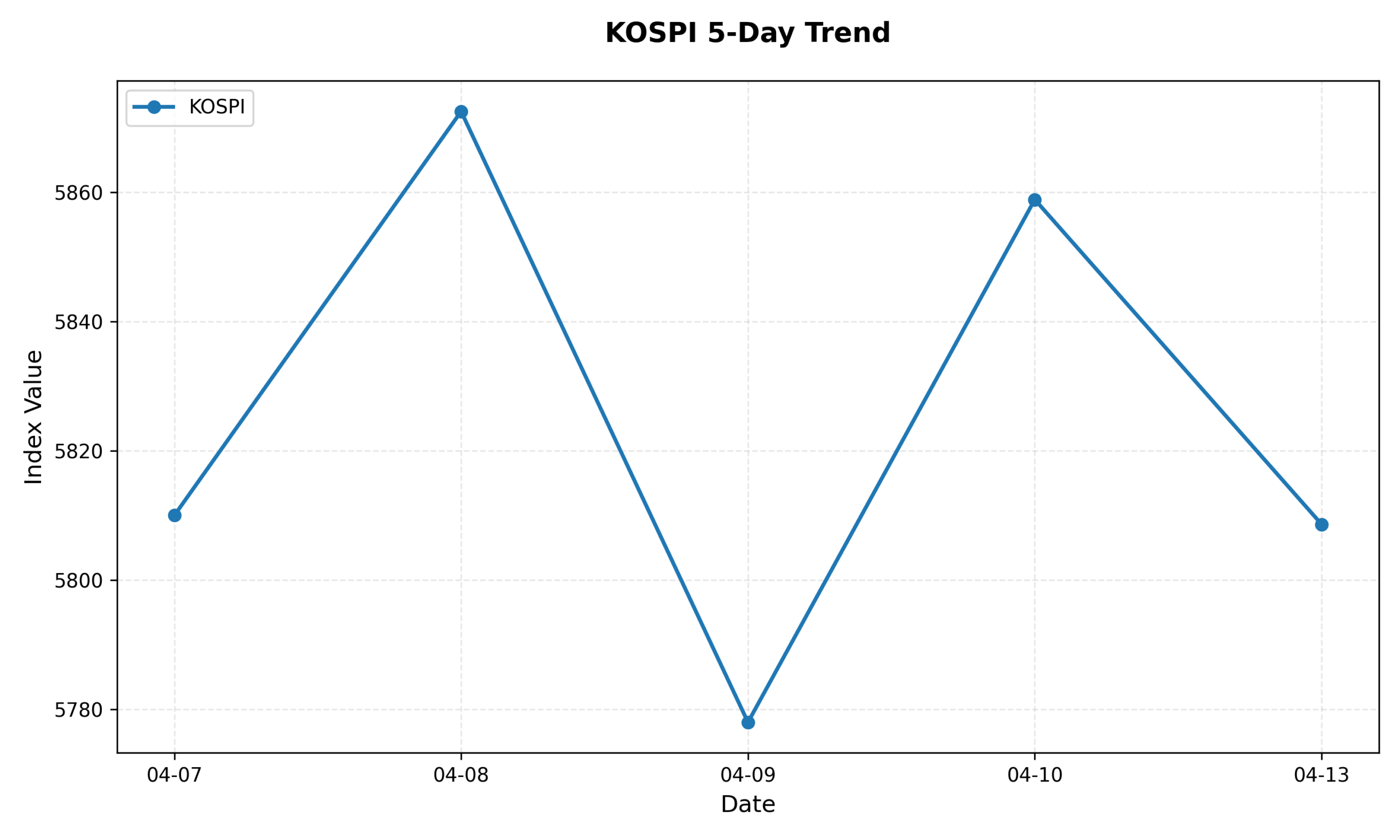
The South Korean stock market entered Tuesday with a heavy sense of caution as the benchmark KOSPI index continues to experience significant KOSPI Volatility Conflict. Following a turbulent start to the second quarter of 2026, investors are closely monitoring the escalating situation in the Middle East, which has sent shockwaves through global financial markets. As of the latest close on April 13, 2026, the KOSPI stood at 5,808.62, representing a 0.86% decline from the previous session.
The primary driver of this recent instability is the ongoing military conflict involving Israel, the United States, and Iran. Since the outbreak of hostilities in late February, often referred to as “Operation Epic Fury,” the Korean market has swung wildly between massive gains and sharp corrections. While the early months of 2026 saw an unprecedented rally that pushed the KOSPI past the 6,000 mark for the first time in history, the current KOSPI Volatility Conflict highlights the fragility of these gains in the face of macro-economic uncertainty.
Geopolitical Impact on Tech Giants
Market leaders such as Samsung Electronics (005930) and SK Hynix (000660) have been at the forefront of this volatility. Samsung Electronics, which recently crossed the 200,000 KRW threshold, saw its shares under pressure as supply chain concerns resurfaced. The Middle East conflict poses a direct threat to global logistics and energy prices, both of which are critical for Korea’s export-oriented semiconductor industry.
Despite the broader market decline, the KOSDAQ managed a slight rebound, closing at 1,099.84, up 0.57%. This divergence suggests that while large-cap stocks are being hammered by macro fears, some retail investors are seeking opportunities in mid-cap tech and biotechnology sectors, which are perceived as slightly more insulated from immediate geopolitical risks.
Macro Outlook and KOSPI Volatility Conflict
The KOSPI Volatility Conflict is further exacerbated by the “won’s” recent weakness. As investors flock to safe-haven assets like the US dollar, the Korean won has touched multi-year lows, making imports more expensive and complicating the Bank of Korea’s inflationary outlook. Analysts at kstocks.net suggest that the market is currently in a “wait-and-see” mode, pending further developments in the ceasefire negotiations reported earlier this week.
Data Source: Naver Finance, KRX
Investment Disclaimer: Trading in financial markets involves significant risk. The information provided in this article is for informational purposes only and does not constitute financial advice. Investors should conduct their own research or consult with a qualified financial advisor before making any investment decisions.
About the Author
Johnny Lee
Seoul-based full-time professional and individual investor with 5 years of active experience in the Korean stock market. My approach combines value investing with medium-term swing trading across a diversified portfolio. In 2025, my personal account delivered a 72.9% return, significantly outperforming the KOSPI benchmark. I started KStocks to bring the Korean investor perspective directly to a global English-speaking audience.
Korean blog: blog.naver.com/taximum | Contact: golchoa@gmail.com