Market Overview: KOSPI Hits Historic Milestone
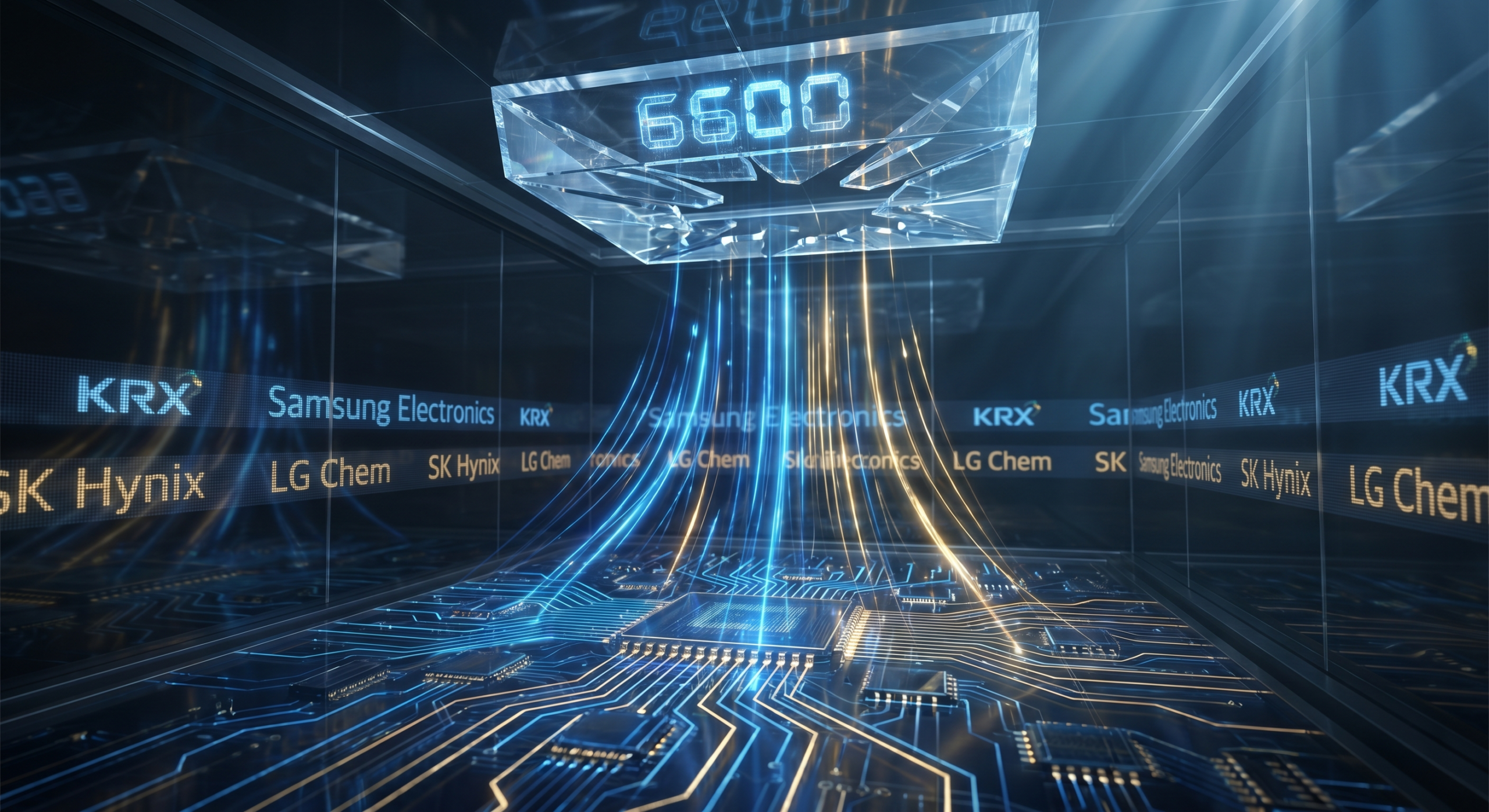
The South Korean stock market reached a historic milestone on April 28, 2026, as the benchmark KOSPI (KOSPI.KS) index surged to a fresh all-time high. Despite a mixed performance across sectors and selling pressure from foreign investors, the heavyweights in the semiconductor industry continued to drive the broader market to uncharted territory. The index has shown remarkable resilience, maintaining its upward trajectory even as global economic uncertainties persist.
The KOSPI closed at 6,641.02 points, marking an increase of 25.99 points or 0.39% from the previous session. During intraday trading, the index even touched a peak of 6,712.73, signaling strong bullish momentum that has persisted throughout the month of April. In contrast, the tech-heavy KOSDAQ (KOSDAQ.KS) index experienced a pull back, closing at 1,215.58 points, down 10.60 points or 0.86%. The divergence between the two indices highlights the concentrated strength in large-cap industrial and semiconductor stocks.
KOSPI 5-Day Trend and Market Sentiment
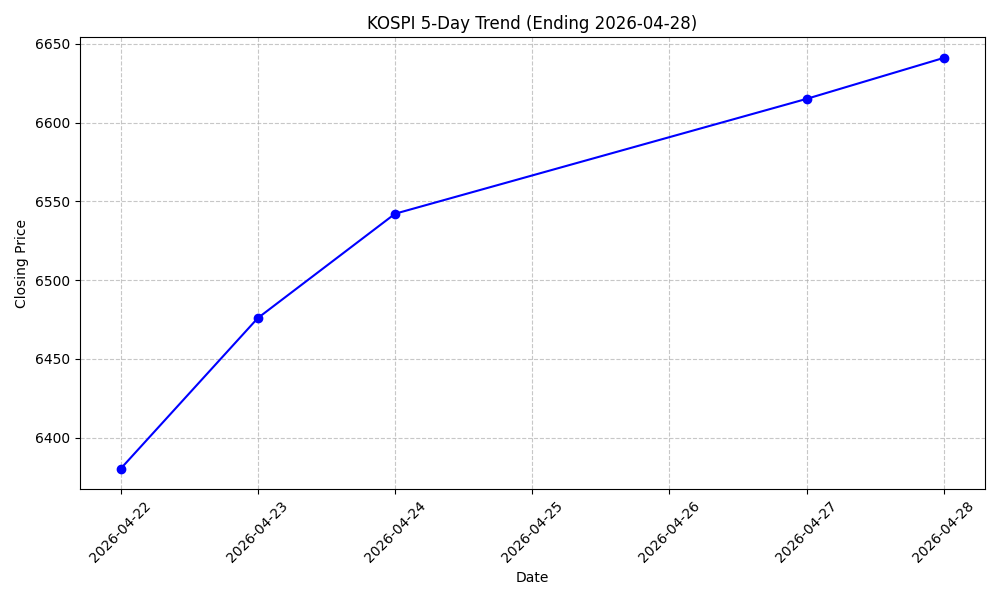
The recent trajectory of the KOSPI has been nothing short of remarkable. Just a few months ago, the index was struggling to maintain the 4,000-point level. However, a combination of robust earnings from the “Big Two” semiconductor giants—Samsung Electronics and SK Hynix—and favorable government policies regarding corporate “Value-Up” initiatives has propelled the market to consecutive record highs. The 5-day trend shows a consistent climb from the 6,300 level to over 6,600, reflecting a strong “FOMO” (fear of missing out) sentiment among institutional and retail investors alike.
Market analysts suggest that the current bull run is driven by structural shifts in the global AI supply chain. South Korean firms, particularly those in the memory and high-bandwidth memory (HBM) sectors, have become indispensable partners for global AI developers. This has led to a re-rating of Korean equities, which were historically traded at a discount compared to their global peers.
Semiconductor Leadership and Top Movers
The day’s gains were primarily led by the semiconductor sector. Samsung Electronics (005930), the crown jewel of the Korean stock market, rose by approximately 1.2%, maintaining its position as the primary driver of the index. Meanwhile, SK Hynix (000660) saw even more aggressive buying, closing up 2.5% as investors cheered the latest breakthroughs in its HBM4 production capabilities.
In the automotive sector, Hyundai Motor (005380) and Kia (000270) showed steady performance, benefiting from strong export data to the North American and European markets. However, the battery sector faced some headwinds. LG Energy Solution (373220) saw a slight decline as concerns over cooling electric vehicle (EV) demand in certain regions weighed on investor sentiment. This sector rotation is becoming a common theme in the 2026 market, where the focus has shifted from “growth at any cost” to “proven profitability in the AI era.”
Closing Summary of Major Indices
| Index | Closing Value | Change (pts) | Change (%) |
|---|---|---|---|
| KOSPI | 6,641.02 | +25.99 | +0.39% |
| KOSDAQ | 1,215.58 | -10.60 | -0.86% |
Investor Flow: Foreign Sellers vs. Institutional Buyers
A notable feature of today’s trading session was the activity of foreign investors. Despite the index reaching a new high, foreign investors were net sellers, offloading approximately 184.5 billion won worth of shares on the KOSPI and 528.9 billion won on the KOSDAQ. This profit-taking by offshore funds was absorbed by domestic institutional investors, who remained bullish on the long-term outlook of the Korean market. Institutional net buying on the KOSPI reached 351.1 billion won, providing the necessary liquidity to sustain the rally.
Retail investors also showed mixed signals, selling on the KOSPI but buying significantly on the KOSDAQ (+796.1 billion won). This suggests that while big-cap stocks are being driven by institutional money, smaller tech stocks are still a playground for individual investors looking for high-growth opportunities in emerging technologies like biotechnology and green energy.
Conclusion and Outlook
As we look forward to the remainder of the quarter, all eyes will be on the upcoming quarterly earnings releases from the major conglomerates. If the earnings can justify the current valuations, there is a strong possibility that the KOSPI could challenge the 7,000-point mark before the end of the year. However, investors should remain cautious about potential volatility arising from global interest rate shifts and geopolitical tensions.
For more detailed analysis and real-time updates on the Korean stock market, visit kstocks.net. Our platform provides comprehensive data and insights to help you navigate the dynamic K-Stock landscape.
Data Source: Naver Finance, KRX (Korea Exchange)
Disclaimer: This article is for informational purposes only and does not constitute financial advice. Investing in the stock market involves risks, including the loss of principal. Always perform your own research and consult with a professional financial advisor before making any investment decisions.
About the Author
Johnny Lee
Seoul-based full-time professional and individual investor with 5 years of active experience in the Korean stock market. My approach combines value investing with medium-term swing trading across a diversified portfolio. In 2025, my personal account delivered a 72.9% return, significantly outperforming the KOSPI benchmark. I started KStocks to bring the Korean investor perspective directly to a global English-speaking audience.
Korean blog: blog.naver.com/taximum | Contact: golchoa@gmail.com