KOSPI Declines Amid Geopolitical Uncertainty

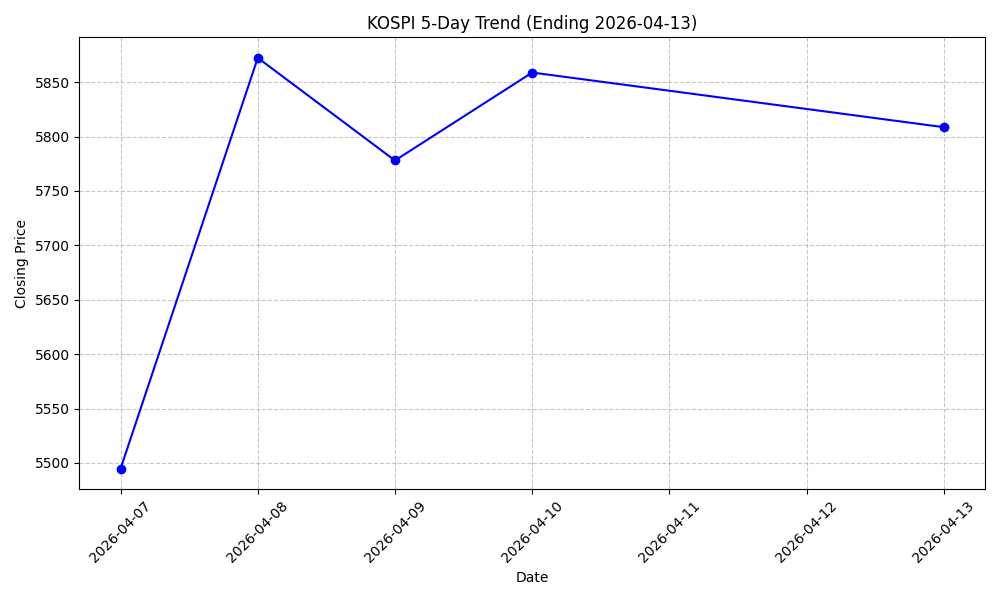
The South Korean benchmark KOSPI (KRX: KOSPI) and the tech-heavy KOSDAQ (KRX: KOSDAQ) showed divergent paths on Monday, April 13, 2026. While the KOSPI retreated from its recent highs due to escalating geopolitical tensions in the Middle East, the KOSDAQ managed to post modest gains, driven by individual stock plays in the healthcare and renewable energy sectors.
Market Summary and Key Indices
The KOSPI index closed at 5,808.62, down 50.25 points or 0.86% from the previous session. The market opened lower and remained under pressure throughout the day as news of the collapse of ceasefire negotiations between major regional powers in the Middle East dampened investor sentiment. In contrast, the KOSDAQ index edged up by 6.21 points or 0.57% to finish at 1,099.84, showing resilience despite the broader market cautiousness.
| Index | Closing Value | Change (Points) | Change (%) |
|---|---|---|---|
| KOSPI | 5,808.62 | -50.25 | -0.86% |
| KOSDAQ | 1,099.84 | +6.21 | +0.57% |
Tech Giants Lead the Retreat
The day’s losses were largely concentrated in the heavyweight semiconductor sector. Market bellwether Samsung Electronics (005930) fell approximately 3% as investors worried about potential supply chain disruptions and a slowdown in global demand for AI-related hardware. Similarly, SK Hynix (000660), which recently touched the psychological milestone of 1 million KRW, also saw a 3% correction, closing near 1,027,000 KRW.
Analysts noted that the “Korea Discount” might be resurfacing as geopolitical risks overshadow the strong fundamental performance of the nation’s tech sector. “The sudden shift in the Middle East political landscape has triggered a ‘risk-off’ sentiment, leading to profit-taking in stocks that have rallied significantly this year,” said a market strategist at a major Seoul-based brokerage.
Foreign and Institutional Investor Sentiment
Foreign investors turned net sellers on the main board, offloading 456.4 billion KRW worth of shares. Institutional investors were even more bearish, recording a net sell of 701.6 billion KRW. The selling pressure was absorbed by retail investors, who purchased a net 750 billion KRW, continuing their trend of supporting the market during dips.
On the KOSDAQ, the trend was similar, with foreign investors selling 148.7 billion KRW. However, strong buying interest in pharmaceutical and biotech stocks helped the secondary index stay in positive territory. Celltrion (068270) and other biotech majors were among the gainers, as investors looked for defensive hedges against global industrial volatility.
Outlook and Global Context
The Korean market’s performance today reflects its sensitivity to global political developments. With the U.S. Federal Reserve maintaining a “higher for longer” stance on interest rates to combat persistent inflation, the added layer of geopolitical risk is making investors more selective. For more updates on the Korean financial landscape, visit kstocks.net.
Investors are advised to keep a close eye on the ongoing diplomatic efforts in the Middle East and the upcoming quarterly earnings releases from major Korean corporations, which will provide a clearer picture of whether the AI-driven rally can sustain its momentum through the second half of 2026.
Data Source: Naver Finance, KRX (Korea Exchange)
Disclaimer: This article is for informational purposes only and does not constitute financial advice. Investing in the stock market involves risk, and past performance is not indicative of future results. Consult with a professional advisor before making any investment decisions.
About the Author
Johnny Lee
Seoul-based full-time professional and individual investor with 5 years of active experience in the Korean stock market. My approach combines value investing with medium-term swing trading across a diversified portfolio. In 2025, my personal account delivered a 72.9% return, significantly outperforming the KOSPI benchmark. I started KStocks to bring the Korean investor perspective directly to a global English-speaking audience.
Korean blog: blog.naver.com/taximum | Contact: golchoa@gmail.com