
Market Overview: KOSPI Plunges to 5,100 Support Zone

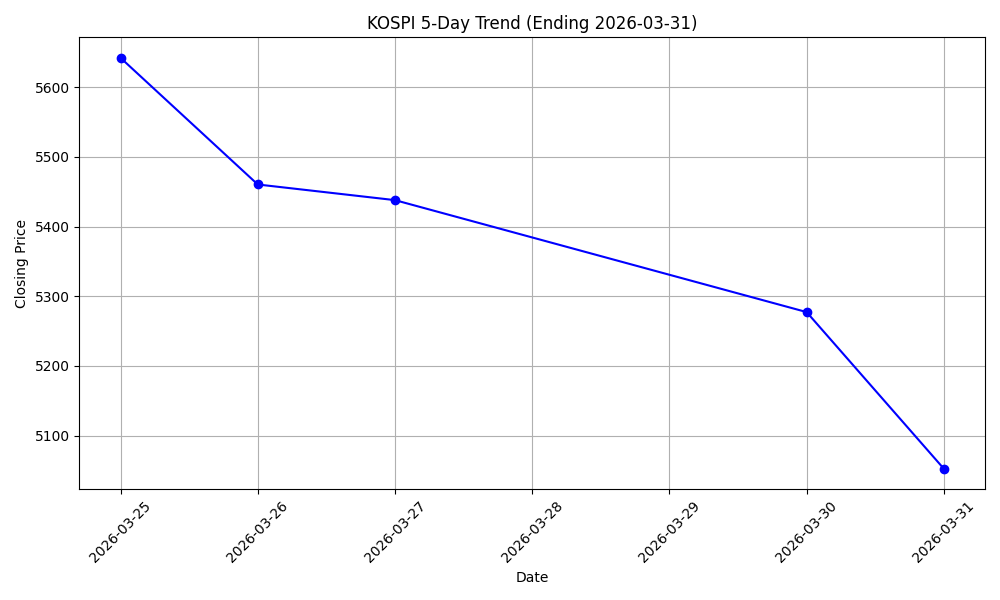
The South Korean stock market experienced a significant downturn on Tuesday, March 31, 2026, as investor sentiment was dampened by persistent geopolitical tensions in the Middle East and a weakening Korean won. The benchmark KOSPI (ticker: ^KS11) plummeted by 4.26%, closing at 5,052.46 points, while the tech-heavy KOSDAQ (ticker: ^KQ11) fell even more sharply by 4.94% to finish at 1,052.39 points.
Closing Summary
| Index | Closing Value | Change (Pts) | Change (%) |
|---|---|---|---|
| KOSPI | 5,052.46 | -224.84 | -4.26% |
| KOSDAQ | 1,052.39 | -54.66 | -4.94% |
Foreign Investor Flows and Currency Pressure
Foreign investors remained net sellers on the main board, offloading approximately 38.38 billion won worth of shares. This marks a continued trend of capital flight as the global risk appetite remains low. The Korean won also faced immense pressure, with the exchange rate hovering near the 1,530 level against the U.S. dollar, further exacerbating the sell-off in domestic equities.
Sector Performance and Individual Movers
The decline was broad-based, hitting major large-cap stocks. Samsung Electronics (005930) and SK Hynix (000660) both saw significant drops as the global semiconductor outlook turned cautious amid trade disruptions. Defense stocks showed some resilience but were unable to offset the broader market decline.
- Samsung Electronics (005930): Faced heavy selling pressure due to global tech sentiment.
- SK Hynix (000660): Tracked the decline in the broader semiconductor sector.
- Hyundai Motor (005380): Impacted by currency volatility and global supply concerns.
Market Outlook and Themes
The primary theme driving today’s market was the “Triple Whammy” of geopolitical risk, currency devaluation, and foreign capital exit. Analysts suggest that the 5,000-point mark for the KOSPI will be a critical psychological support level in the coming days. For more detailed analysis on Korean stocks, visit kstocks.net.
Data Source: Naver Finance, KRX
Disclaimer: This article is for informational purposes only and does not constitute financial advice. Investing in the stock market involves risk, and past performance is not indicative of future results. Please consult with a qualified financial advisor before making any investment decisions.
About the Author
Johnny Lee
Seoul-based full-time professional and individual investor with 5 years of active experience in the Korean stock market. My approach combines value investing with medium-term swing trading across a diversified portfolio. In 2025, my personal account delivered a 72.9% return, significantly outperforming the KOSPI benchmark. I started KStocks to bring the Korean investor perspective directly to a global English-speaking audience.
Korean blog: blog.naver.com/taximum | Contact: golchoa@gmail.com