South Korean Markets Tumble as Middle East Tensions Weigh on Investor Sentiment
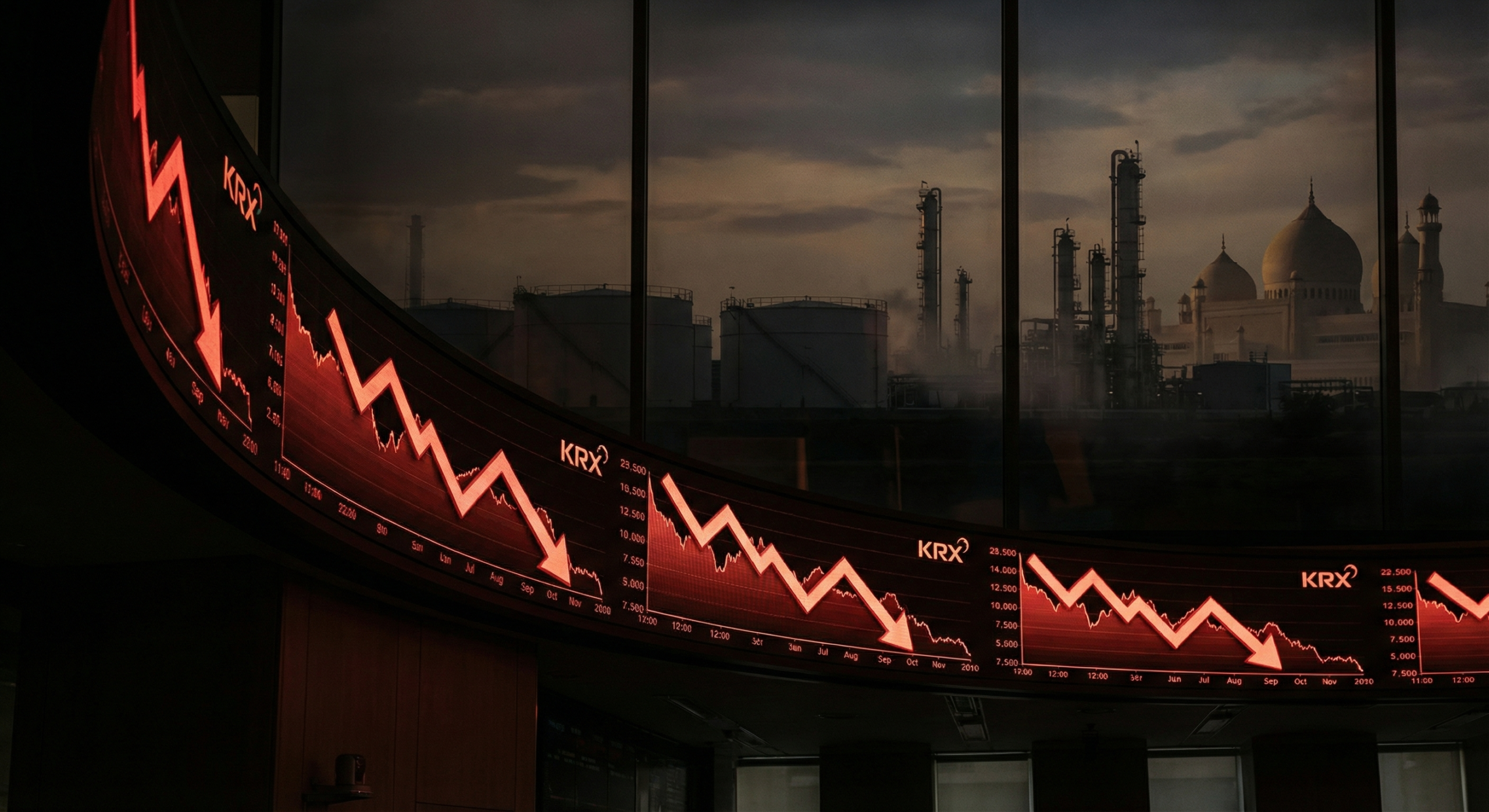
KOSPI (^KS11) and KOSDAQ (^KQ11) closed lower on Monday, mirroring the broader global uncertainty surrounding escalating geopolitical risks in the Middle East. High-growth sectors, particularly technology and semiconductors, faced significant selling pressure throughout the session.
Market Summary
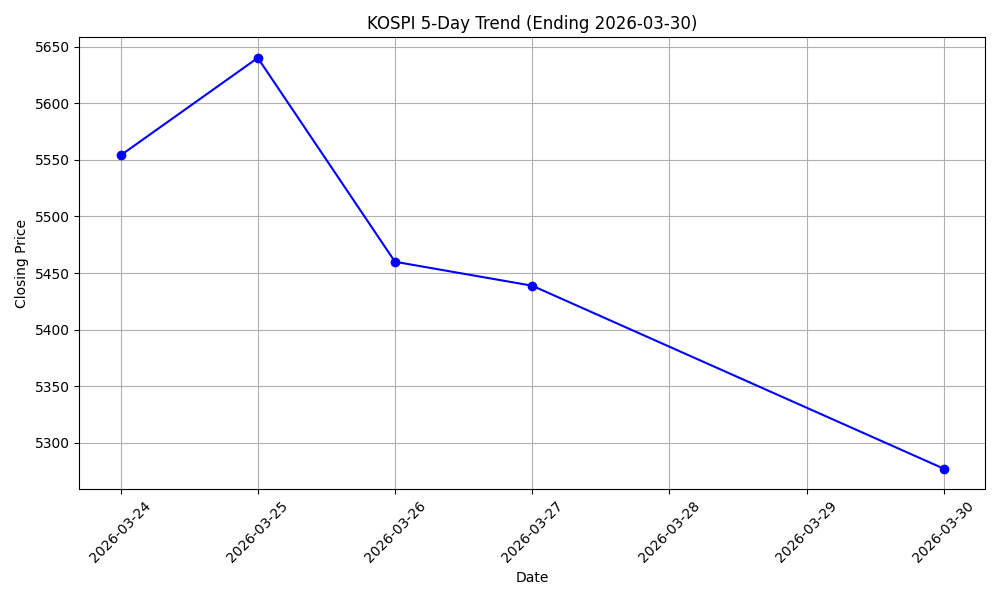
The benchmark KOSPI finished the day at 5,277.30, falling 161.57 points or 2.97% from the previous session. The tech-heavy KOSDAQ also saw a sharp decline, closing at 1,107.05, down 34.46 points or 3.02%.
| Index | Closing Value | Change (Points) | Change (%) |
|---|---|---|---|
| KOSPI | 5,277.30 | -161.57 | -2.97% |
| KOSDAQ | 1,107.05 | -34.46 | -3.02% |
Foreign Investor Flows
Foreign investors remained net sellers on the main board, offloading 21,305 billion KRW worth of shares. Meanwhile, retail investors and institutional buyers attempted to cushion the fall with net purchases of 8,943 billion KRW and 8,815 billion KRW, respectively. The heavy foreign exit was largely attributed to the strengthening US dollar and a shift toward safe-haven assets.
Key Sector and Stock Performance
The semiconductor sector, the backbone of the Korean stock market, took a heavy hit. Samsung Electronics (005930) and SK Hynix (000660) saw double-digit losses in their share prices compared to last week’s highs as concerns over supply chain disruptions in the Middle East intensified. Conversely, defense-related stocks and energy shares showed resilience as oil prices climbed.
- Top Movers:
- Samsung Electronics (005930): Down significantly amid global risk-off sentiment.
- SK Hynix (000660): Faced sharp selling pressure following Nasdaq’s weakness.
- Hyundai Motor (005380): Retreated as global demand concerns resurfaced.
Analysis: Middle East Geopolitics and High Volatility
The primary driver for today’s market crash was the heightened geopolitical risk in the Middle East. Investors are increasingly wary of a potential wider conflict that could lead to spiked energy costs and prolonged inflation. For a trade-dependent economy like South Korea, these external shocks often lead to rapid capital outflows, as seen in today’s foreign selling spree. Analysts expect continued volatility until a clearer diplomatic path emerges in the Middle East.
For more detailed analysis on the Korean financial landscape, visit kstocks.net.
Data Source: Naver Finance, KRX
Investment Disclaimer: The information provided in this article is for informational purposes only and does not constitute financial or investment advice. Stock market investments carry inherent risks, and past performance is not indicative of future results. Always consult with a qualified financial advisor before making any investment decisions.
About the Author
Johnny Lee
Seoul-based full-time professional and individual investor with 5 years of active experience in the Korean stock market. My approach combines value investing with medium-term swing trading across a diversified portfolio. In 2025, my personal account delivered a 72.9% return, significantly outperforming the KOSPI benchmark. I started KStocks to bring the Korean investor perspective directly to a global English-speaking audience.
Korean blog: blog.naver.com/taximum | Contact: golchoa@gmail.com