
Market Overview: KOSPI Plummets as Foreign Investors Retreat

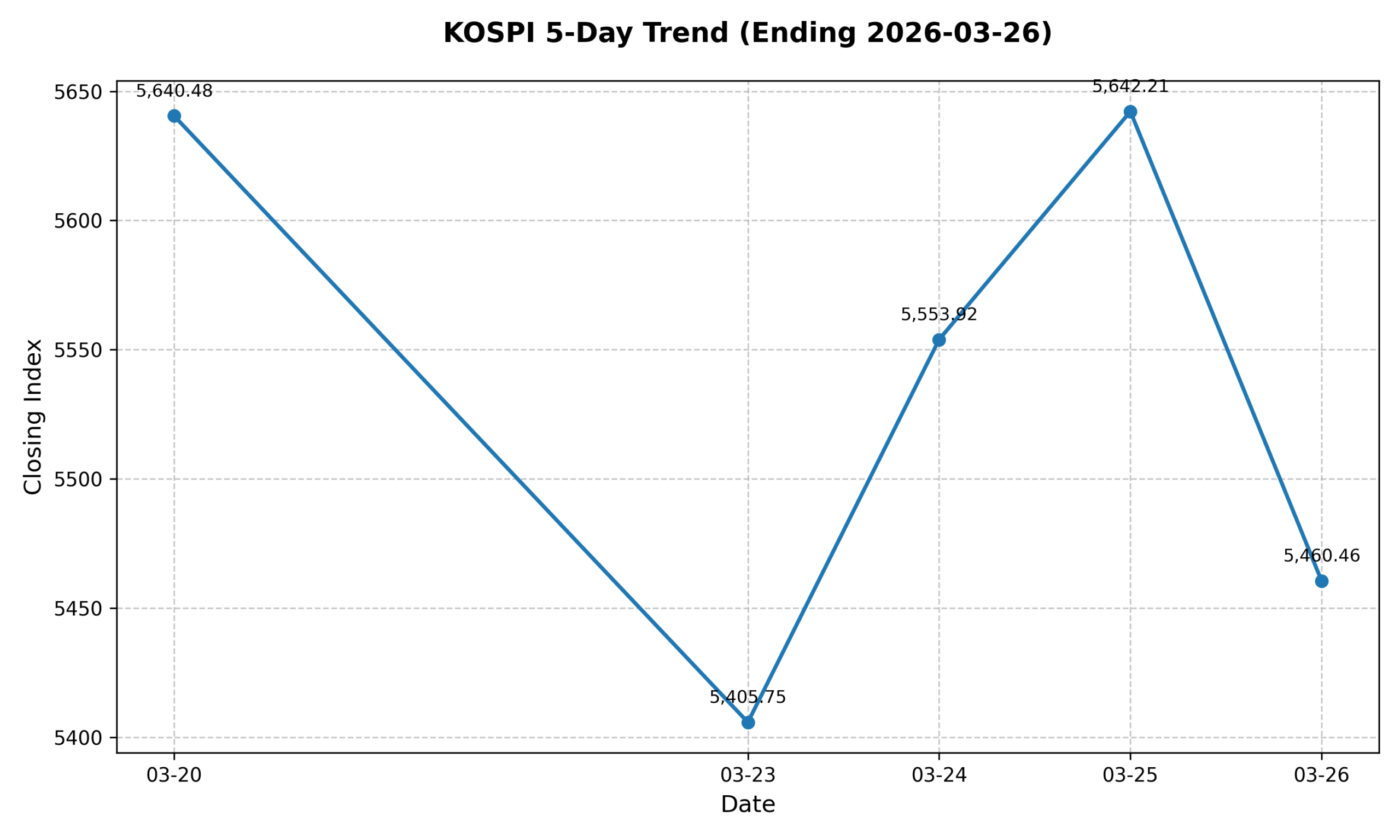
KOSPI (^KS11) and KOSDAQ (^KQ11) tickers showed a significant downturn today. The South Korean benchmark KOSPI closed at 5,460.46, falling 181.75 points or 3.22% from the previous session. The secondary KOSDAQ index followed suit, dropping 22.91 points or 1.98% to finish at 1,136.64. The sharp decline was primarily driven by aggressive net selling from foreign investors, coupled with heightened volatility in the foreign exchange market as the Korean won weakened significantly against the U.S. dollar.
Foreign Investor Flows and Market Sentiment
The day was dominated by a large-scale sell-off by foreign participants. In the KOSPI market, foreign investors recorded a net sell of approximately 30,980 million won, while institutional investors also sold a net 3,389 million won. Retail investors attempted to absorb the pressure with a net purchase of 30,598 million won, but it was insufficient to prevent the index from sliding below the 5,500 level. In the KOSDAQ market, foreigners were also net sellers of 3,015 million won.
Key Stock Movers
The heavyweight semiconductor sector took a substantial hit, weighing heavily on the main index. Samsung Electronics and SK Hynix saw notable declines, reflecting the cautious stance of global investors towards high-growth tech shares amid macroeconomic uncertainties. However, a few individual stocks managed to defy the trend:
| Stock Name | Ticker | Status |
|---|---|---|
| Samsung Electronics | 005930 | Down |
| SK Hynix | 000660 | Down |
| LG Energy Solution | 373220 | Down |
Market Themes: Currency Pressure and Geopolitical Woes
Analysts pointed to the surge in the USD/KRW exchange rate, which touched the 1,500 won mark, as a critical factor behind the foreign exodus. The weakening won erodes the dollar-denominated returns for international investors, triggering a flight to safety. Furthermore, ongoing geopolitical tensions in the Middle East have sparked concerns over energy supply disruptions, adding another layer of risk to the export-heavy Korean economy. The “Korea Discount” remains a persistent theme as investors weigh structural risks against current valuations.
For more detailed analysis and real-time updates on the Korean equity markets, visit kstocks.net.
Data Source: Naver Finance, KRX
Investment Disclaimer: The information provided in this article is for informational purposes only and does not constitute financial or investment advice. Investing in the stock market involves risks, including the potential loss of principal. Readers should conduct their own research or consult with a qualified financial advisor before making any investment decisions.
About the Author
Johnny Lee
Seoul-based full-time professional and individual investor with 5 years of active experience in the Korean stock market. My approach combines value investing with medium-term swing trading across a diversified portfolio. In 2025, my personal account delivered a 72.9% return, significantly outperforming the KOSPI benchmark. I started KStocks to bring the Korean investor perspective directly to a global English-speaking audience.
Korean blog: blog.naver.com/taximum | Contact: golchoa@gmail.com