
Harim Holdings (003380)
Harim Holdings (003380): A Guide to Analyzing Short Selling Trends and Market Sentiment
Short selling data provides a unique window into market sentiment and the strategic positions of institutional investors. For Harim Holdings (003380), recent trends in short selling volume and outstanding balances offer critical insights for global investors. This guide breaks down the key metrics and recent data to help you interpret the current market pressure on Harim Holdings.
Data Overview: January 9, 2026 – February 10, 2026
During this 23-day analysis period, we observed significant shifts in the short selling landscape for Harim Holdings. Understanding these numbers is essential for gauging whether the stock is facing a temporary setback or a prolonged bearish sentiment.
Understanding Key Short Selling Terms
To analyze the data effectively, we must first define the core metrics used in the Korean market:
- Short Selling Volume: The total number of shares sold short. This is split into regular trades (Uptick Rule applied) and exceptions (Market makers, LP, etc.).
- Short Selling Amount: The monetary value of the shorted shares (KRW).
- Outstanding Short Position Balance: The total value of short positions that have not yet been covered (bought back). This is the most critical indicator of bearish sentiment.
Analysis of Recent Trends (As of Feb 10, 2026)
The latest data points to a high-pressure environment for Harim Holdings:
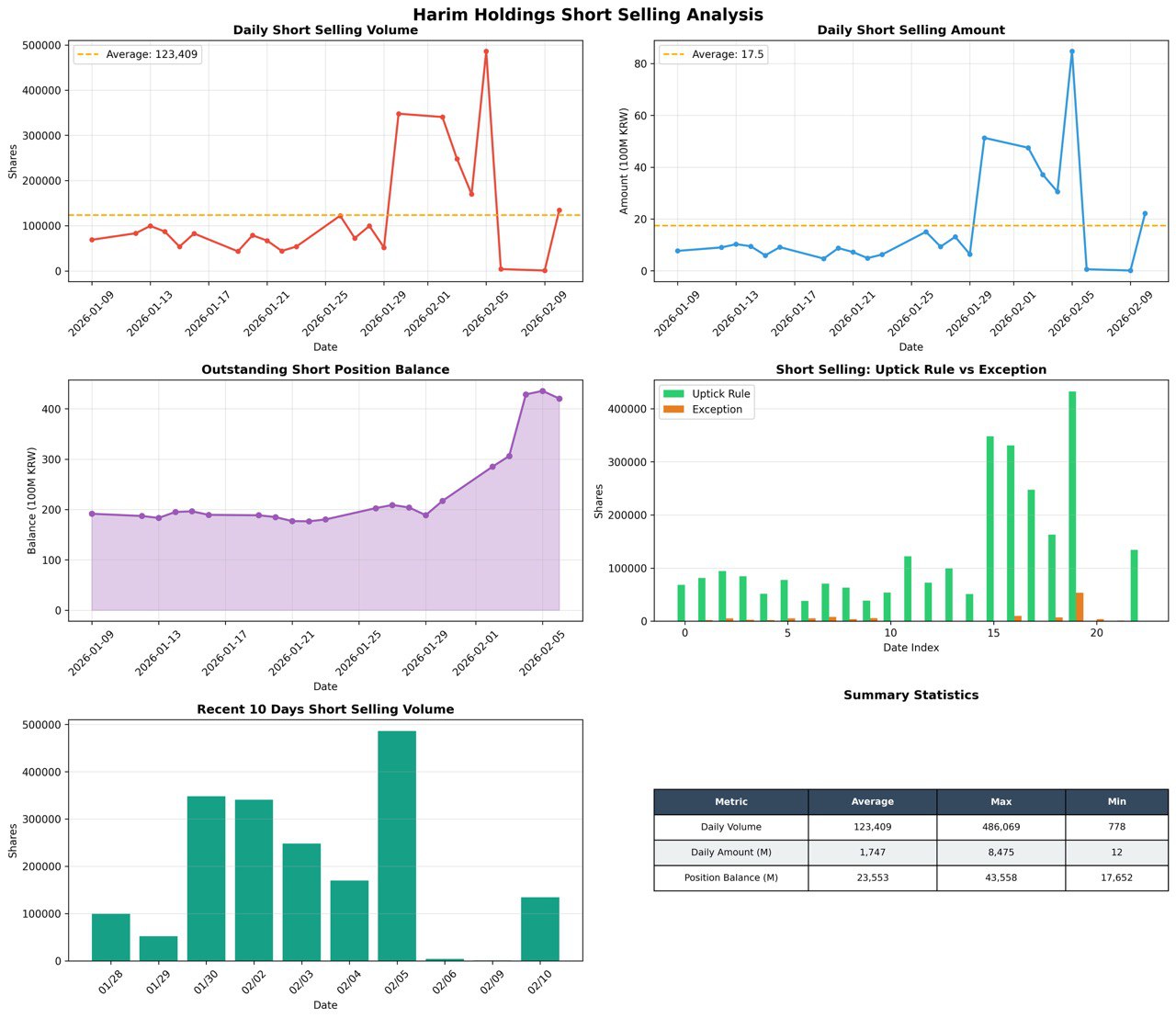
- Short Selling Volume: 134,444 shares
- Short Selling Amount: KRW 2.2 billion
- Outstanding Balance: Approximately KRW 420.3 billion
Notably, the outstanding short position balance has surged by roughly KRW 228.8 billion since January 9th. This indicates that short sellers are aggressively betting on further price declines.
Interpreting the Data Charts
When reviewing the visual data, focus on these specific patterns (see the integrated chart above):
- Daily Volume and Amount: Spikes in these charts (like the peak on Feb 5th with 486,069 shares) indicate points where short sellers were most active.
- Outstanding Balance Trend: An upward-sloping line here suggests increasing bearish pressure. Conversely, a downward trend may signal “Short Covering”—where sellers buy back shares to lock in profits or minimize losses.
- Uptick Rule vs. Exceptions: A high percentage of exceptions often indicates strategic institutional involvement rather than general retail sentiment.
Investor Perspective: The Bull and Bear Case
The Bear Case (Negative Signals): The massive outstanding balance of KRW 420.3 billion suggests that institutional investors expect near-term weakness. The fact that this position has more than doubled since January is a strong signal of prevailing bearish dominance.
The Bull Case (Potential Opportunities): High short interest can lead to a “Short Squeeze.” If the stock price unexpectedly rises, short sellers may be forced to buy back shares quickly to cover their positions, leading to a rapid surge in price. Additionally, the recent slowdown in daily short selling volume since Feb 5th could hint at waning bearish momentum.
How to Use This Information
- Track the Balance: Monitor the Outstanding Short Position Balance daily. A decrease could be the first sign of a trend reversal.
- Monitor Spikes: Watch for days when volume is 3x the average (120k shares). These are turning points.
- Combine with Fundamentals: Short data tells you what investors are doing, but not necessarily why. Combine this with news on Harim’s subsidiaries like Pan Ocean or Jeil Feed.
Compare these metrics with current trends in Woori Financial Group or other major Korean holdings to diversify your risk.
Disclaimer: This post is for informational purposes only and does not constitute financial advice. Short selling data is historical and does not guarantee future results. Always consult with a professional advisor before investing.
Tags: Harim Holdings, 003380, Short Selling, Korea Stock Market, Short Squeeze, Institutional Investing, Market Sentiment, K-Finance
About the Author
Johnny Lee
Seoul-based full-time professional and individual investor with 5 years of active experience in the Korean stock market. My approach combines value investing with medium-term swing trading across a diversified portfolio. In 2025, my personal account delivered a 72.9% return, significantly outperforming the KOSPI benchmark. I started KStocks to bring the Korean investor perspective directly to a global English-speaking audience.
Korean blog: blog.naver.com/taximum | Contact: golchoa@gmail.com
1 thought on “Harim Holdings (003380): A Guide to Analyzing Short Selling Trends and Market Sentiment”