Samsung Electronics (005930) · SK Hynix (000660) · NAVER (035420) · Kakao (035720)

Global Semiconductor Chip Fear Rattles South Korean Markets
The South Korean stock market faced a severe correction on March 26, 2026, as a wave of semiconductor chip fear swept through global financial hubs. The KOSPI index, which had been performing strongly earlier in the year, plummeted by over 3%, marking one of the steepest single-day declines in recent months. Investors are increasingly concerned about supply chain stability and potential demand saturation in the high-end AI chip market, which has been the primary driver of the Korean economy’s recent growth.
According to data from Naver Finance and the Korea Exchange (KRX), the KOSPI closed at 5,460.46, down 181.75 points or 3.22% from the previous session. The sell-off was broad-based but particularly concentrated in the heavyweights of the semiconductor sector. Samsung Electronics (005930) and SK Hynix (000660), which together account for a massive portion of the index’s market capitalization, led the downward charge as institutional and foreign investors moved to hedge their positions against growing global uncertainty.
KOSPI Market Overview and 5-Day Trend
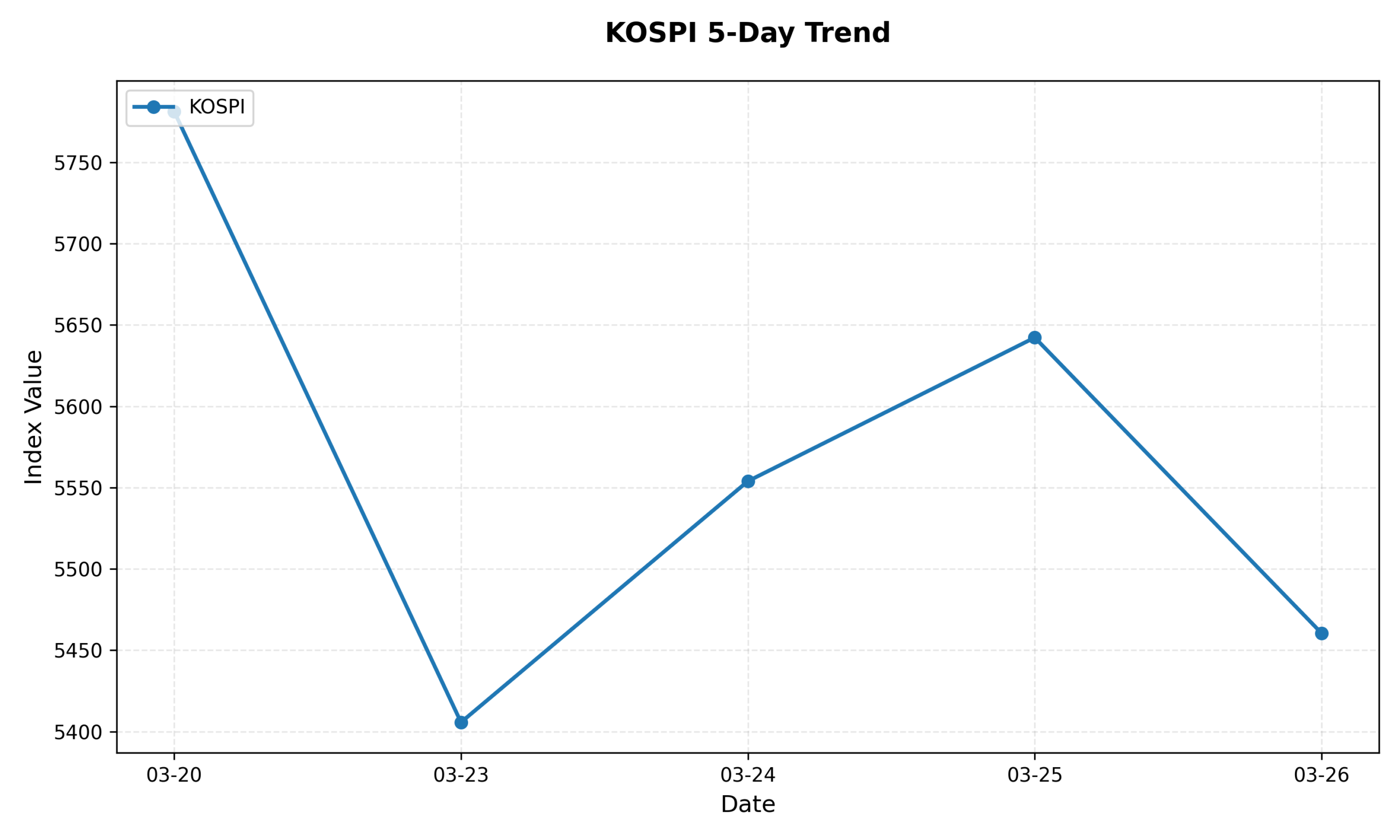
The recent performance of the KOSPI highlights the volatility that has returned to the Seoul bourse. After reaching record highs above the 6,000 mark earlier in 2026, the index has entered a period of consolidation. The 5-day trend shows a fluctuating path, with a sharp drop on March 23 followed by a brief recovery, only to be overshadowed by the massive plunge on March 26. This “V-shaped” attempt at recovery was ultimately thwarted by the intensifying semiconductor chip fear that dominated the news cycle toward the end of the week.
Technical analysts suggest that the 5,400 level will be a crucial support zone for the KOSPI in the coming days. If the index fails to hold this level, further downside toward 5,200 could be expected. However, the volume during the recent sell-off suggests that some bottom-fishing activity might be occurring, as long-term investors look for value amidst the carnage. The KOSDAQ index also suffered, closing at 1,136.64, a decrease of 1.98%, indicating that the sentiment has soured across both major South Korean boards.
Semiconductor Giants Under Pressure: Samsung and SK Hynix
The epicenter of the market’s turmoil is undeniably the semiconductor industry. Samsung Electronics and SK Hynix have been the darlings of the AI-driven rally, but they are now facing a “perfect storm” of challenges. Beyond the macro-level semiconductor chip fear, specific industry reports have emerged regarding a “helium crunch” that could impact production timelines. Helium is a critical component in the manufacturing process of advanced logic and memory chips, and supply disruptions from major exporters like Qatar have put South Korean chipmakers in a vulnerable position.
SK Hynix, which has been leading the HBM (High Bandwidth Memory) market, saw its stock price come under significant pressure as competitors ramp up production and concerns about pricing power in the second half of 2026 begin to surface. Meanwhile, Samsung Electronics is navigating a complex transition as it attempts to narrow the gap in the foundry business while maintaining its dominance in mobile and consumer electronics. The market’s reaction on March 26 reflects a fundamental shift in sentiment from “growth at any cost” to a more cautious “show me the sustained earnings” approach.
The Impact of Global Semiconductor Chip Fear on Supply Chains
The term semiconductor chip fear is not just a catchphrase; it represents a tangible anxiety regarding the fragility of the global tech ecosystem. As geopolitical tensions simmer and trade policies become increasingly protectionist, the free flow of critical raw materials and finished components is no longer guaranteed. For South Korea, a nation whose export-oriented economy is built on the foundation of technology, these shifts are existential threats. Analysts at kstocks.net note that the current environment requires a more nuanced approach to portfolio management, focusing on companies with diversified supply chains and strong domestic market positions.
Tech Platforms and Secondary Indices
While semiconductors took the brunt of the damage, other sectors were not immune to the negative sentiment. NAVER (035420) and Kakao (035720), the titans of the South Korean internet and platform space, also saw their stock prices slide. These companies are often viewed as proxies for domestic consumer sentiment and liquidity conditions. As the Bank of Korea (BOK) monitors inflationary pressures and the potential for prolonged high-interest rates, the valuation of high-growth platform stocks remains under scrutiny.
The KOSDAQ market, home to many small-to-mid-sized tech firms and biotech companies, showed similar signs of distress. The secondary board’s 1.98% drop suggests that risk-off sentiment is pervasive. However, some niche sectors, such as defense and renewable energy, have shown relative resilience, providing a potential hedge for investors looking to diversify away from the volatile semiconductor and internet sectors.
Market Outlook and Strategy: Navigating the Uncertainty
As we look toward the opening of the market on March 27, 2026, the primary question is whether the semiconductor chip fear will persist or if the market has sufficiently priced in the negative news. Historically, sharp corrections in the KOSPI have often been followed by periods of sideways trading or gradual recoveries, provided the underlying economic fundamentals remain sound. The current export data for South Korea continues to show strength, particularly in automotive and machinery sectors, which could provide a buffer for the overall economy.
Investors are advised to maintain a balanced perspective. While the headlines may seem dire, the long-term outlook for the semiconductor industry remains positive, driven by the inevitable expansion of AI, 6G, and autonomous systems. Short-term volatility is the price of admission for participating in these high-growth themes. Strategic accumulation of quality stocks during these dips, rather than panic-selling, has historically been the more successful approach for retail investors in the Korean market.
Data Citation: This report is based on official market data provided by Naver Finance, the Korea Exchange (KRX), and the Bank of Korea (BOK). Financial news and sentiment analysis were cross-referenced with reports from major South Korean financial news outlets and global indices.
Investment Disclaimer: The information provided in this article is for informational purposes only and does not constitute financial advice. Investing in the stock market involves risks, including the potential loss of principal. Investors should conduct their own research or consult with a qualified financial advisor before making any investment decisions.
About the Author
Johnny Lee
Seoul-based full-time professional and individual investor with 5 years of active experience in the Korean stock market. My approach combines value investing with medium-term swing trading across a diversified portfolio. In 2025, my personal account delivered a 72.9% return, significantly outperforming the KOSPI benchmark. I started KStocks to bring the Korean investor perspective directly to a global English-speaking audience.
Korean blog: blog.naver.com/taximum | Contact: golchoa@gmail.com