
KOSPI Index · KOSDAQ Index
KOSPI Closing Reversal: Market Suffers Sharp Pullback Amid BOJ Rate Freeze and Geopolitical Risks
Market Overview: A Sharp Reversal After Wednesday’s Surge
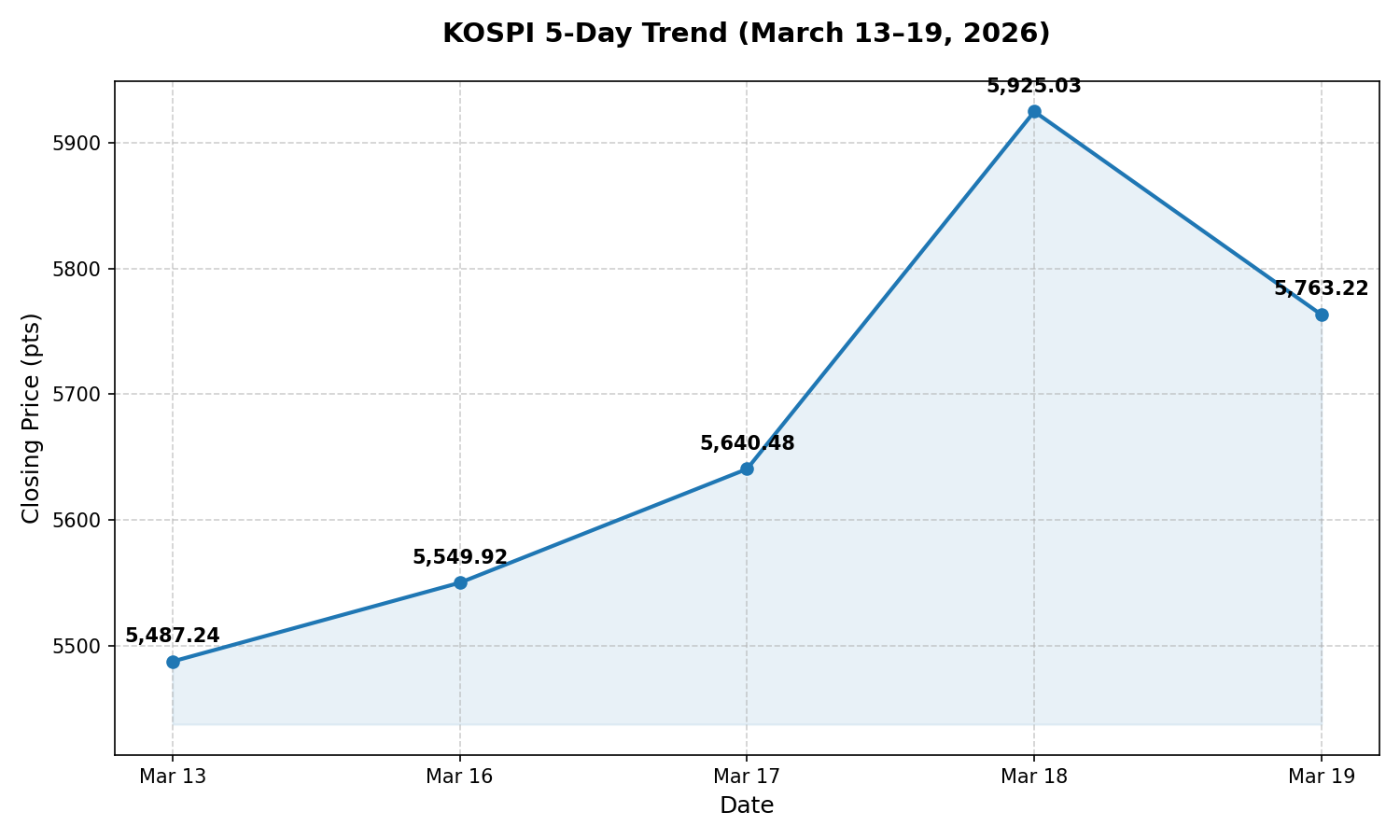
The South Korean equity market experienced a significant KOSPI closing reversal on Thursday, March 19, 2026, as investor sentiment soured following a hawkish-leaning rate freeze by the Bank of Japan (BOJ) and escalating tensions in the Middle East. The benchmark KOSPI index closed at 5,763.22, shedding 161.81 points, or 2.73%, effectively erasing more than half of the previous day’s record-breaking gains.
The tech-heavy KOSDAQ also followed suit, finishing the day at 1,143.48, down 1.79%. The reversal comes as a stark contrast to Wednesday’s 5.04% surge, highlighting the current extreme volatility in the regional markets. Analysts point to the “triple whammy” of monetary policy uncertainty, soaring energy prices, and geopolitical instability as the primary drivers of today’s sell-off.
Key Drivers: BOJ Stance and Middle East Conflict
The KOSPI closing reversal was largely triggered by the Bank of Japan’s decision to maintain its interest rates while issuing a stern warning regarding inflation risks driven by surging oil prices. This stance, coupled with intensifying conflict in the Middle East, has led to a flight to safety among global investors. As oil prices breached the $110 mark, concerns over persistent global inflation and subsequent rate hikes in major economies dampened the appetite for riskier assets like Korean tech stocks.
Furthermore, the escalation of regional conflicts has heightened the “Korea Discount” once again, as foreign investors prioritized liquidity over long-term holdings in emerging markets. The USD/KRW exchange rate remained elevated, closing near the 1,500 level, further pressuring the domestic equity indices.
Foreign and Institutional Investment Flows
Data from the KRX indicates that foreign investors turned net sellers today, offloading an estimated 640.5 billion won worth of shares. This follows a brief period of net buying on Wednesday. Institutional investors, who had propped up the market with record purchases just 24 hours ago, also trimmed their positions, though to a lesser extent, with a net sell of approximately 120 billion won. Retail investors were the primary net buyers, absorbing over 700 billion won in shares as they sought to “buy the dip,” though their efforts were insufficient to halt the index’s decline.
Sector Highlights and Top Movers
Major technology and semiconductor shares were hit hardest. Samsung Electronics (005930) fell 3.72% to close at 200,750 won, while its peer SK Hynix (000660) dropped 4.17% to 1,012,000 won. The broader semiconductor index suffered as investors reconsidered growth projections amidst rising input costs and potential supply chain disruptions.
Despite the broad market decline, several individual stocks posted impressive gains. Chin Hung International (002780) and Anam Electronics (008700) both surged by 29.98%, hitting their daily price limits. SK Securities (001510) also rose significantly by 15.16% on high trading volume. SK Eternix (475150) gained 25.35% as investors rotated into specific energy-related plays.
| Ticker | Company | Closing Price | Change (%) |
|---|---|---|---|
| 001510 | SK Securities | 2,165 | +15.16% |
| 047040 | Daewoo E&C | 16,090 | +8.20% |
| 002780 | Chin Hung Int | 1,045 | +29.98% |
| 475150 | SK Eternix | 53,500 | +25.35% |
Looking Ahead
The current volatility suggests that the Korean market remains highly sensitive to external macro factors. Investors are advised to monitor further developments in the Middle East and the upcoming Federal Reserve policy communications. For more detailed insights into the domestic market structure, you can refer to our latest report on South Korea Market Trends.
Data Source: KRX (Korea Exchange), Investing.com, Yonhap News Agency.
Investment Disclaimer: The information provided in this article is for informational purposes only and does not constitute financial or investment advice. Investing in the stock market involves significant risk, and past performance is not indicative of future results. Please consult with a professional financial advisor before making any investment decisions.
About the Author
Johnny Lee
Seoul-based full-time professional and individual investor with 5 years of active experience in the Korean stock market. My approach combines value investing with medium-term swing trading across a diversified portfolio. In 2025, my personal account delivered a 72.9% return, significantly outperforming the KOSPI benchmark. I started KStocks to bring the Korean investor perspective directly to a global English-speaking audience.
Korean blog: blog.naver.com/taximum | Contact: golchoa@gmail.com